
Why should I join the »Savinjska.KupujLokalno.si« (SKL) project?
As a member of the SKL community, I focus only on my own business, while the marketing, promotion and online visibility of our offer is guaranteed by the »SKL project«. According to data from the Statistical Office of the RS, the Savinjska statistical region has 250,000 inhabitants, of whom 200,000 are aged between 15 and 74. 75% or 150,000 of us look for information about goods and service providers on the internet. Let us join the SKL group in the cloud and make our offer visible 150,000 times.
Presentation of the Savinjska.KupujLokalno.si (SKL) project
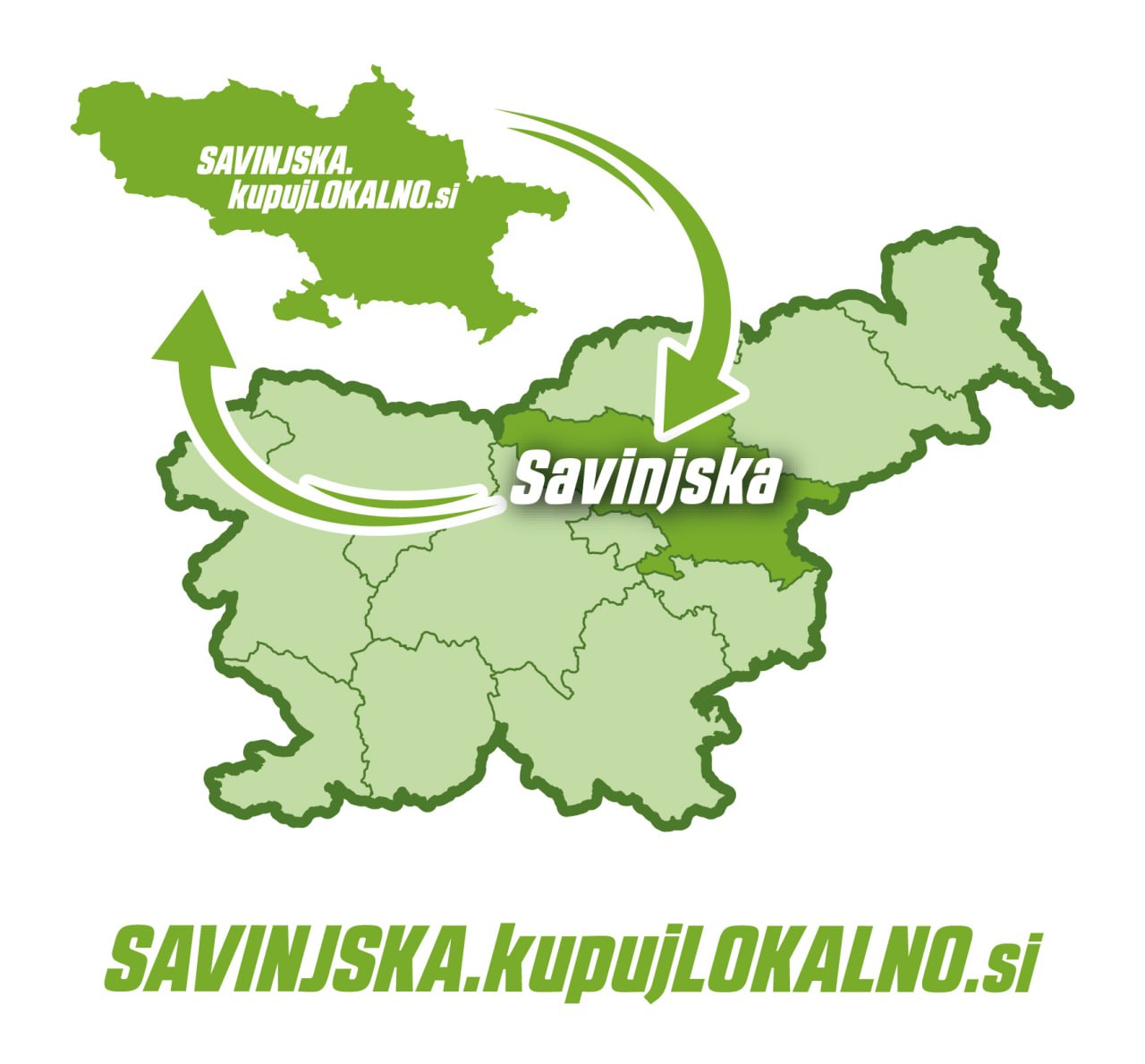
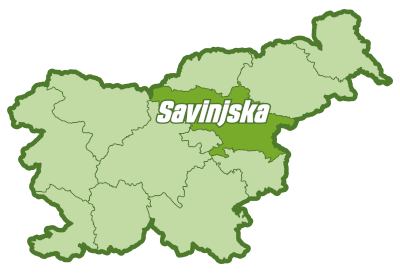
The Savinjska statistical region is one of the twelve statistical regions of Slovenia. It covers the alpine area of the Upper Savinjska Valley as well as part of the Kamnik-Savinja Alps, the Lower Savinjska Valley, the Kozjansko hills, the Upper Dravinja Valley and the Velenje basin.
Quite a few strategic studies have been made that outline the directions for the development of the Slovenian economy and tourism for the whole of Slovenia, as well as for individual areas with their own characteristics, from the mountain world to the Pannonian plain, from urban offerings to the offerings of the coast and its hinterland. What all the studies have in common is that they are made to shape goals and development directions, so they are TOP-DOWN and touch the ground unsystematically. The purpose and goal of the SKL project is to bring together all the resources offered by the environment and the population of each region. Designing such an offer ensures a boutique character and shows all the details that a given location can provide. More is described in the document The Point of Decision is also the Point of Turning
Through DIGITALISATION, where the basis is the register of active legal entities (LE) from the Ajpes register, and with supplemented public data about LEs, we have laid the foundation for including and bringing together offerings by a wide range of criteria at the local level and beyond. We have set up a model where each LE can decide with what and in what form it will join the SKL project. (Joining the Savinjska.KupujLokalno.si project)
Our approach is BOTTOM_UP, as we work from the ground up. Every LE with its registered office or a branch in the territory of the Savinjska statistical region can join us and enter the shared SKL project. The structure of the computer UDS cloud ensures that LE data is stored on our servers, located in Slovenia and under our control. The SKL platform is provided in the cloud, which communicates (exchanges data) with the LE or its representative, who takes care of regular publications, monitors traffic and the performance of publications, and ensures the accuracy of the data. The UDS system handles MVC communication with internet users and delivers the right, up-to-date information in the right place in real time. Information can be accessed on all devices connected to the internet that offer access via web browsers. Application programming interfaces (APIs) are available for programming specific applications and upgrades.
For a smart way to join SKL, a phased development path of inclusion is available:
- Phase 1 is the decision that the LE joins the SKL project and signs an accession statement agreeing to the publication of the data we record on the e-Flyer. We also publish the location of the LE, its branch or registered office, which is shown on the SKL sector map. Once we have digitalised the basic data, the LE at a given location can also join other integrations – UDS projects, as well as create a link to its already existing website.
- Phase 2 is the decision that the LE wants to advertise in an advertising spot on the SKL portal, which we call Digi Jumbo. The LE secures this right by purchasing ITs (InfoTočka small). ITs is the condition for the WHAT'S ON button on the ITs to work. The current content is the LE's poster, which is shown for a certain period from-to in the LE's Digi Jumbo poster space. The current content can also include a presentation of the LE on Facebook, and the WHAT'S ON button itself can be integrated into the LE's existing online presentations.
- Phase 3 is the upgrade of the ITs. This is about setting up a website. A website is the space where the LE's data is hosted. UDS does not offer data hosting in the classic way, where all of an LE's data, including a private database, is kept separate; instead it offers everyone one robust database where the data of all LEs is stored and is already brought together at its core, so it does not need to be copied anywhere for more demanding filtering. The APIs prepare a dynamic model in an MVC structure for further display on web pages.
Put simply, ITs makes it possible to open content buttons and to upgrade the e-Flyer, where buttons appear on the flyer so that the flyer becomes a small website. ITs is also the carrier of the website, where the web content, texts, images and other materials that the LE advertises via the SKL portal are stored. - Phase 4 is the upgrade of ITs into an IT, which provides for its own domain, multilingual content, the inclusion of e-News, e-Catalogues, e-Galleries, thematic maps, etc.
- Phase 5 provides for the upgrade of the IT so that it becomes the carrier of an association, that is, the structure that the SKL portal also offers, which is based on this kind of IT as the carrier of the Savinjska.KupujLokalno.si portal.