
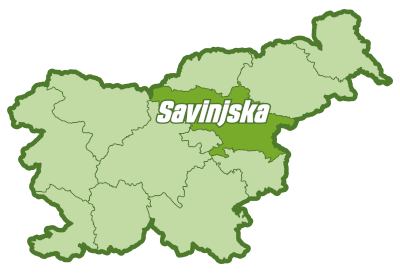
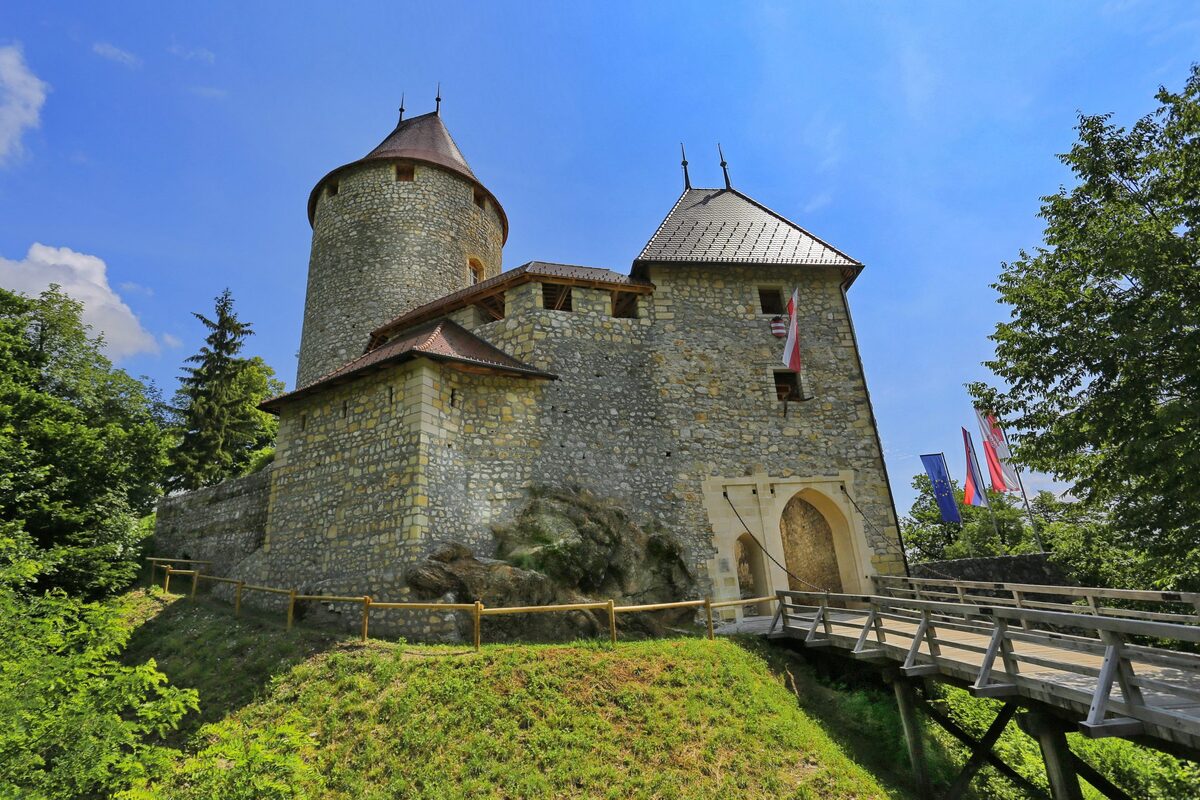
Žovnek Castle
Žovnek Castle is considered one of the oldest castles in Slovenia, although the builders of its original form remain unknown. The first recorded owners, mentioned by literature from the 12th century, were members of the Savinjski family, who renamed themselves Žovneški around the year 1150.
When the Žovneški were first mentioned in written sources, in addition to their home castle they also owned Ojstrica Castle (in the Municipality of Tabor), Šenek Castle above Polzela and Libenstein above Prebold. Over time, the Žovneški increased their estates, influence and military power. In 1333, after purchasing the second half of Celje, they moved their administration and residence to that town. On 16 April 1341, Emperor Louis the Bavarian elevated Frederick I to the rank of count by a special charter, and in 1436 the Counts of Celje attained the princely title as well.
Although they moved to Celje, the Žovneški retained a strong connection with their original castle and ancestral symbols. Žovnek Castle thus remained the family seat, where later members of the Counts of Celje lineage often resided. After the death of Ulrich II, the last Prince of Celje, in 1456 near Belgrade, the castle and other Celje estates passed into the hands of the Habsburgs, who managed the estate through stewards. The last owner to reside in the castle was Jožef Čokl von Ruhethal, who in 1816 built the new Žovnek manor in the valley and moved into it.
After 1816 the castle began to decay, once the last inhabitants left it. Today the castle is preserved as a ruin, which is gradually being restored.
We enter the castle complex across a bridge through a restored entrance portal, which was once divided into two parts – for pedestrians and for horsemen.
To the left of the entrance stands the most striking part of the ruins – the round defensive tower, which served the Žovneški for defence. The tower is a two-storey building, which had its central part on the first floor, where the castle chapel was once located.
To the right of the entrance portal, the remains of the southern outer and inner walls are visible.
The central part of the castle once represented the residential section, or palatium, which today is almost entirely demolished. The only remaining elements of the former palatium are two "spires", which were fully restored in 2008.
