
Gora Oljka
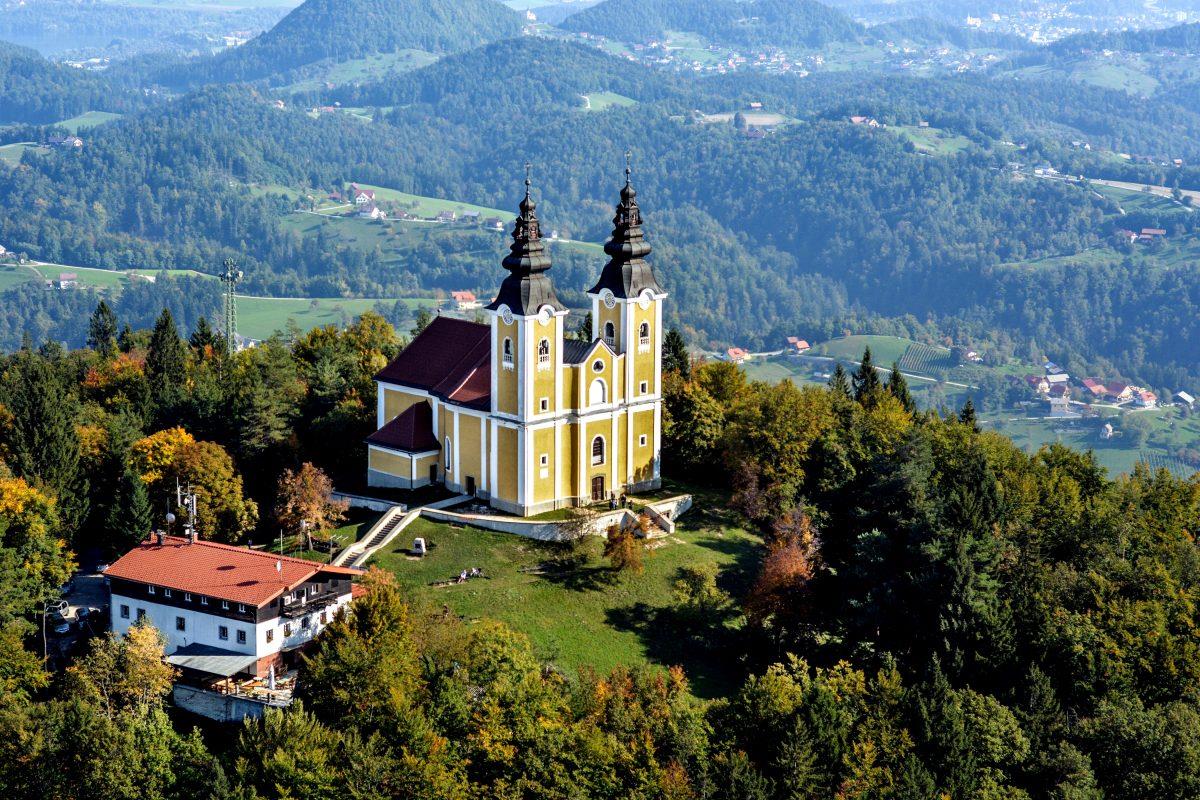
Gora Oljka, or by its old name Križna gora (also Oljska gora and the Savinja Šmarna gora), is a 733-metre-high[1] karst isolate above Polzela. It represents a fine vantage point, from which one can see the Posavje Hills, Paški Kozjak, part of the Kamnik-Savinja Alps, and the Karavanke.
Gora Oljka is first mentioned in known documents as Križna gora as far back as 1243. From the mid-17th century, a large cross stood on the top of the mountain, and from 1753 also a chapel of St. Jodok and St. Agnes. This is mentioned in a contract between the Šoštanj landowner and the Polzela Maltese order of knights. Gora Oljka got its name from the painting on the main altar of the Church of the Holy Cross, on which the renowned Baroque painter Fortunat Bergant depicted Jesus on the Mount of Olives.
On the predella of the altar of the Church of the Holy Cross is Fortunat Bergant's painting of Jesus on the Mount of Olives, after which Gora Oljka got its name.
Church of the Holy Cross
The imposing twin-towered church on the top of Gora Oljka was built in 1757. The locals say that the church majestically reigns over Polzela and that the very sight of it announces the location of their home town from afar. The church was built from 1754 to 1757 under the direction of the master builder Nepomuk Mayer, on living rock and on artificially levelled terrain. It is oriented in a south-to-north direction and is characteristically undulating with its outer shell, which reflects the Baroque style of construction. At the main entrance the church has two 38-metre-high bell towers that flank the 21-metre-high façade. Beneath the church itself, an underground sanctuary with a Holy Sepulchre is still preserved today. The interior is a unified oval space with a prominent presbytery and a raised choir loft.
In the mid-18th century, the sculptor Ferdinand Gallo created the main altar, on account of which the Church of the Holy Cross is today counted among the magnificent monuments. On the altar with a large screen of angels, right by the altar table, are sculptures of Christ and the twelve apostles at the Last Supper. At the far left is Judas Iscariot with a purse of gold coins in his hand. The pulpit is also richly carved. In the 18th century, several priests also served on the mountain.
Source: Wikipedia