Nazarje Franciscan Monastery
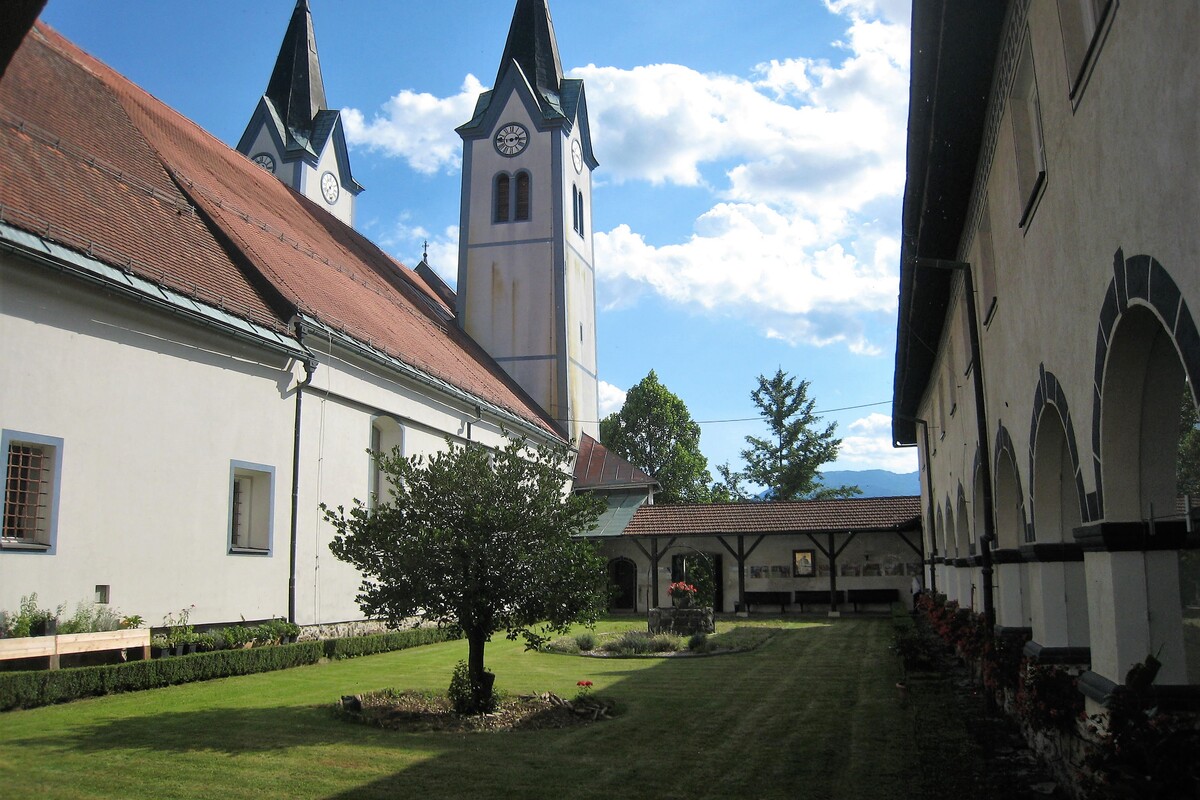
The Nazarje Franciscan Monastery is a Roman Catholic Franciscan monastery in the Parish of Nazarje. It is located on the Gradišče hill next to the Church of the Annunciation of Mary.
Originally, a chapel of the Mother of God stood on the hill, built between 1624 and 1628 at the behest of the Ljubljana bishop Tomaž Hren. Over the years it was visited by ever more pilgrims who needed care. For this reason, Hren's successor, the Ljubljana bishop Rinaldo Scarlicchio, handed the chapel over to the Franciscans in 1632. They built a monastery and the present church next to the chapel.
Alongside spiritual care, the Franciscans also looked after the education of children and helped people through medicine. A pharmacy probably operated in the monastery from the very beginning. It was usually run by two lay brothers, physicians by training, who also practised their surgical and medical work outside the monastery, which at times even led to disputes with the provincial doctors. The best known physicians were brother Salomin Lipold (†1822) and brother Kancij Rak (†1825), and before them father Aleksander Perger (†1736). In 1825, after the death of the last physician, the pharmacy ceased to operate.
On the initiative of the Celje district governor, a public elementary school was founded in Nazarje in February 1786, for which a special room was set aside in the monastery; the teaching there was carried out exclusively by Franciscans, mostly fathers. In the last years before the Second World War, the school was attended by around 130 children.
To this day, the library is a source of pride for the monastery. Although it is not the richest among the monastery libraries in Slovenia, it holds several precious books. Among them are: a codex of commentaries on the Holy Scripture by the renowned interpreter of sacred texts Nicholas de Lyra from 1508; the translation of the Gospels from Greek into Latin by Erasmus of Rotterdam (alongside the Greek original and Erasmus's translation, the Vulgate is also printed in the third column for comparison); Luther's translation of the Holy Scripture into German from 1535; Trubar's translation of the Gospels (Ta celi Novi Testament našiga Gospudi inu Izveličarja Iesusa Christusa, na dva majhina dejla rezdilen ...) from 1557; Dalmatin's Bible from 1584. The library has five incunabula, old musical scores, and the oldest items are parchments from the 13th century. In addition to religious works, the library also contains historical, geographical, legal and classical books with dictionaries and lexicons, as well as medical professional books, and also various instructions for writing letters, collections of letters, and a few calligraphy exercises.
During the Second World War, the monastery was occupied by the Germans and the fathers were expelled. Towards the end of the war, partisans mined and destroyed part of the monastery. After the war, the Franciscans restored it with the help of locals.
In 2007, three fathers lived in the monastery.
Source: https://sl.wikipedia.org/wiki/Fran%C4%8Di%C5%A1kanski_samostan_Nazarje

