Internet Use in Slovenia
Internet Use in Slovenia
According to data from the Statistical Office of the Republic of Slovenia for the first quarter of 2022, 89% of people aged 16-74 used the internet, and 84% used it several times a day. The largest share of users was in the Osrednjeslovenska statistical region (93%), the smallest in the Pomurska region (80%). 93% of households with at least one member aged between 16 and 74 had internet access at home.
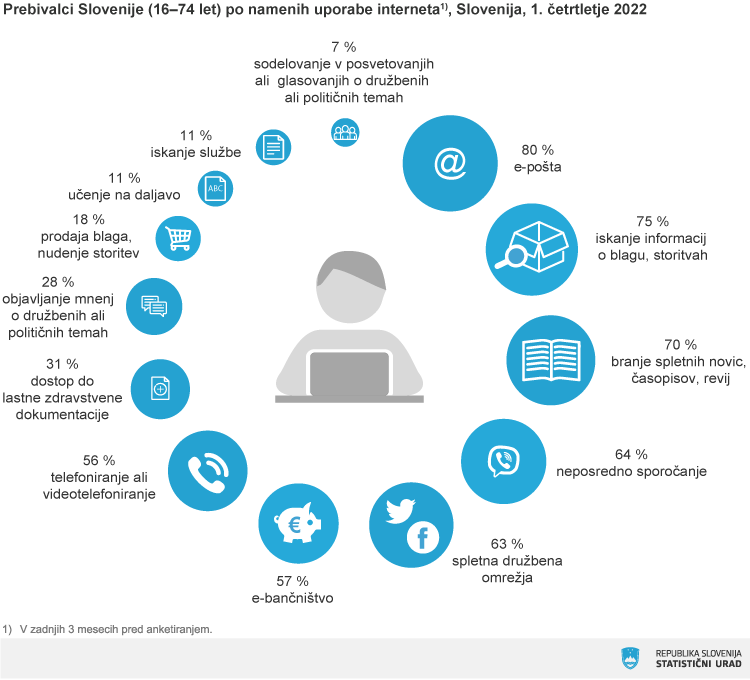
- Of these, a remarkable 75% regularly use the internet to search for goods and services. Based on the information they gather, they then decide on a purchase.
- Social networks are used by 63% of internet users.
👉 Put into numbers, around 1,260,000 people in Slovenia regularly use the internet to look up information about products and services.
👉 The social network Facebook, meanwhile, is used by a good 1,000,000 people.
Internet Use by Statistical Region in Numbers
• Osrednjeslovenska region 🔎 searching for goods and services - 330,000 people, the social network FB is used by 280,000 people.
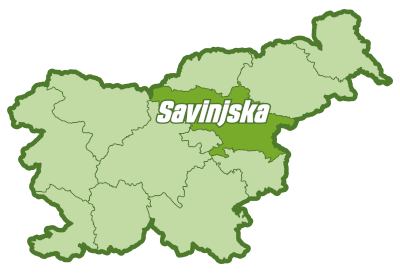
• Savinjska region 🔎 searching for goods and services - 156,000 people, the social network FB is used by 130,000 people.
Internet Use by Municipality in Numbers
• City Municipality of Velenje 🔎 searching for goods and services - 20,000 people, the social network FB is used by 17,000 people.
• City Municipality of Celje 🔎 searching for goods and services - 29,000 people, the social network FB is used by 24,000 people.
• Municipality of Šoštanj 🔎 searching for goods and services - 5,200 people, the social network FB is used by 4,400 people.
• Municipality of Šentjur 🔎 searching for goods and services - 11,600 people, the social network FB is used by 9,700 people.
Nine out of ten primary, secondary or university students also learned via the internet
37% of residents also used the internet for learning. 21% used online learning materials (e.g. audiovisual content, e-textbooks, educational software), 20% took part in an online course, and 16% communicated with lecturers or fellow pupils and students via online audio or video tools such as MS Teams or Zoom. 11% studied remotely as part of formal education. The internet was most often used for work-related and personal learning: 22% of users learned online for work purposes and 19% for personal purposes (e.g. using YouTube), while 10% used the internet as part of secondary, higher or university education.
Three quarters of residents, or 75%, searched the internet for information about goods and services.
 Smart devices and systems
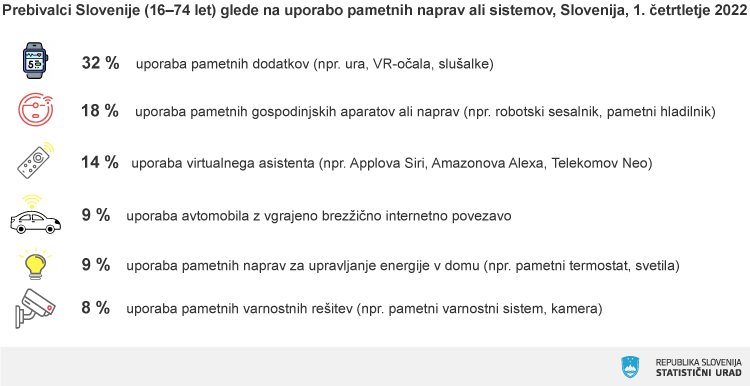
Smart devices or systems had already been used by 67% of residents (in 2020: 63%). These devices are connected to the internet or to one another and enable services such as remote control, adjusting settings and receiving feedback.
A smartwatch, smart wristband, smart glasses, wireless earbuds or other smart accessories were used by almost a third of residents (32%). 9% used cars with a built-in wireless internet connection.
7% used smart devices to monitor blood pressure, blood sugar levels or body weight (e.g. a smart scale) or other smart health and healthcare devices, such as a smart toothbrush or Telekom's E-oskrba service. Smart toys, such as robot toys (including educational toys) or dolls, had been tried by 2%.
Source: Statistical Office of the Republic of Slovenia