
The Information Paradox - When Consolidation Becomes Fragmentation
The Information Paradox in Data Management
When Consolidation Becomes Fragmentation
In the digital society, data is often described as the "new oil" - a source of development, efficiency and smart decisions. Yet in practice, especially in the public sector and in tourism, we see the opposite effect.
Despite the good intentions behind consolidating and centralizing data, that data often becomes increasingly fragmented, opaque and unreliable. This phenomenon is called the information paradox.
1. The Expectation: When Slovenia Shines in the Visitor's Mind as the Perfect Story
Imagine four different visitors to Slovenia:
- A family with two children from Germany, dreaming of a peaceful break in nature - a lakeside walk, safe forest trails, a picnic and a homemade dessert.
- Young travelers from the Czech Republic, looking for energy - summer events, music by the river, nightlife and views made for Instagram.
- A cyclist or hiker from Austria, seeking a challenge - well-maintained trails and clear information on difficulty, trail openings and connections.
- An American tourist, drawn to a story - "the land of the First Lady", Sevnica, the castle, local culture and symbolism.
They all have something in common:
they want reliable, clear and up-to-date information, tailored to their interests.
At this point, Slovenia is ideal in their minds - green, safe, boutique, diverse and friendly.

2. The Disappointment: When Searching for Information Becomes a Maze
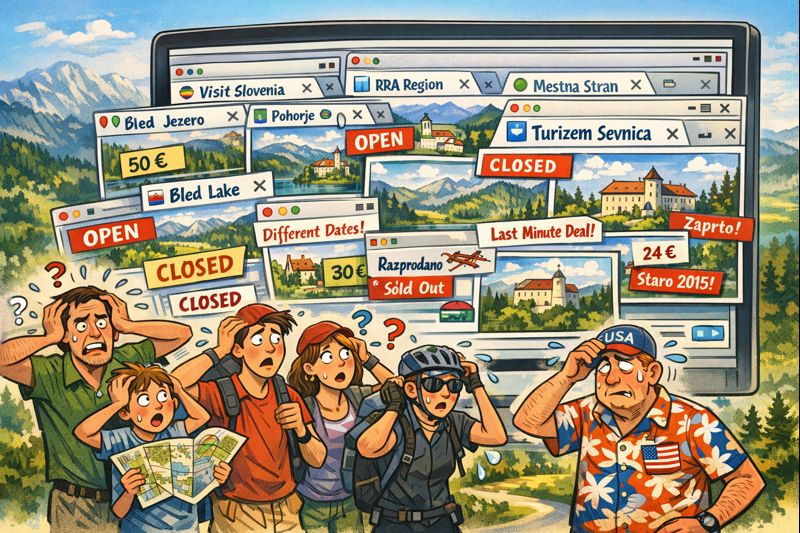
The excitement often falls apart before arrival - already at the information-search stage.
The visitor opens:
- the municipality's website,
- a regional portal,
- the national tourism portal,
- dedicated subpages, event listings and PDFs.
And runs into:
- different prices for the same service,
- "open" on one site and "closed" on another,
- events that exist on only one portal,
- outdated photos and descriptions.
The result?
- the family starts to doubt and postpones its decision,
- the young travelers miss the event,
- the athlete arrives at a closed trail,
- the cultural guest gets a story without up-to-date content.
3. What Is the Information Paradox?
The information paradox arises when a good intention - consolidating and centralizing data - leads to the opposite effect: fragmentation.
Data is created locally, in the field, with providers and municipalities. Instead of staying there as a single source of truth, it is pulled out of context and copied:
- to regional portals,
- to national systems,
- to project and thematic websites.
Each level creates its own database and its own version of the truth. Instead of a single update, we end up with multiple copies - and instead of trust, we get doubt.
4. Tourism in Slovenia as a Textbook Example
In Slovenian tourism, the paradox is clearly visible in the structure: the local level (municipalities, tourist information centers), the regional level (RRA / RDO) and the national level (STO).
Although they all draw on the same local data, that data is often not synchronized, uniformly categorized or kept up to date.
For the user, this means confusion; for the system, it means higher costs, more work and less impact.
5. The Solution: From Silos to Distributed Unity
The solution to the information paradox is not another website, but a different architecture of thinking:
- data stays where it is created,
- a single entry, multiple uses,
- no copying - only sharing.
This way, every visitor sees their own Slovenia, yet everyone is looking at the same reliable data.
6. Conclusion: From Good Intentions to Smart Execution
The information paradox teaches us that without the right architecture, even the best intentions create chaos.
Slovenia is just big enough to make this happen. And just small enough that it can no longer afford fragmentation.
About the Article and Sources
The main content is based on practical experience and reflections on the Slovenian reality of data management in tourism.
The following were taken into account in its preparation:
- The Slovenian Tourism Strategy 2022-2028 (MGRT)
- The EU Open Data Directive (2019/1024) and interoperability concepts
- Examples of good practice from Austria (e.g. Data Hub) and Finland (e.g. the Suomi.fi platform)
- General principles of data architecture (no silos, distributed unity)
- Real challenges faced by Slovenian regional development agencies and municipalities in digitalizing their offer